- Home
- / Electric tug essentials
- / How we specify solutions
MasterMover definitive guide
How does MasterMover approach electric tug specification?
Specifying an electric tug with MasterMover does not require engineering expertise from the buyer. MasterMover's application engineering team manages the full specification process - from initial conversation to confirmed solution - as standard, at no extra cost.
Key Takeaways
With over 30 years of experience across pharmaceutical, ATEX, and aerospace environments, MasterMover specifies solutions built for real-world applications.
Any supplier worth using will ask detailed questions about your environment before recommending a product.
Application engineering is included as standard and not charged as a service.
Solutions are available for ATEX Zone 1 and Zone 2, GMP cleanrooms, and sub-zero environments.
Operators are typically confident after a single familiarisation session.
Our approach
How does MasterMover approach electric tug specification?
Specifying an electric tug with MasterMover does not require engineering expertise from the buyer. We use a tried-and-tested evaluation process to recommend the right solution for your application.
MasterMover's application engineering team manages the full specification process - from initial conversation to confirmed solution - as standard, at no extra cost.
Our process is simple:
We start with an initial conversation to understand the challenge.
We then review all details of your application.
Lastly, we confirm a solution and deliver it.
Specifying an electric tug
Is specifying an electric tug complicated?
No, specifying an electric tug isn’t complicated if you work with the right supplier.
For many organisations, the assumption that the process will be technically complex is a primary barrier to acting on a risk they've already identified.
At MasterMover, application support is included as standard. When a manufacturer, safety manager or facilities lead contacts us with a load movement challenge, our application engineering team handles the full specification process.
This means:
Identifying the right product
Configuring it for the environment
Handling any bespoke requirements
The customer's role is to describe the problem and approve the solution.
Where a standard product fits, we'll specify it.
Where it doesn't fit, we have the in-house engineering capability to adapt.
We do this by adjusting configurations, machine designs and couplings so the solution fits the application, rather than the other way around.
That specialism is why customers get a solution that works, not a product that almost does.
What our specification process looks like
We apply a consistent, structured approach to every application we work on.
Step 1: Initial conversation
Tell us what you're moving, where, and any relevant constraints, for example: space, environment or existing equipment you need to attach to. A phone call or email is enough to get started.
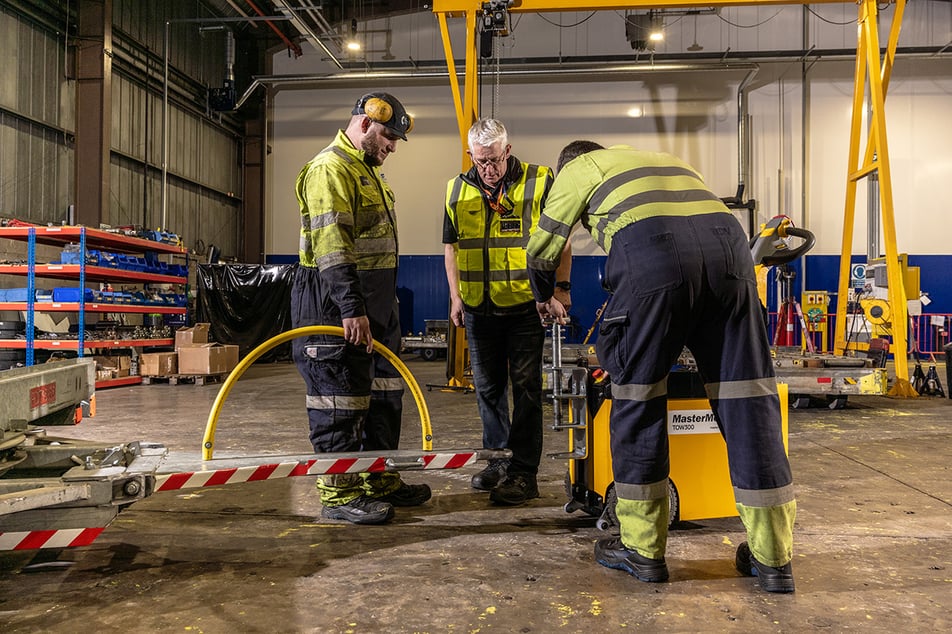
Step 2: Application review
Our application engineers review your requirements and identify the right product configuration. For most standard applications, this is straightforward. For anything more complex, such as an unusual coupling interface, we may ask for additional dimensions or arrange a short video call to confirm the details we need.
Step 3: Solution confirmation
We present a clear recommendation: the product, the configuration, any specific attachments, and cost. Where relevant, we'll also outline different purchase options like short-term hire or rental, as well as training options and service support. There is no obligation at this stage, and the recommendation comes with a clear rationale.
Step 4: Delivery
Your machine arrives configured and ready to operate. If you’ve purchased operator training; we’ll arrange to come to site and familiarise your team with the equipment. Operators are typically confident within a single session.
Environments & industries
How does MasterMover work with specialist environments and specific industries?
The applications that most frequently give buyers pause are those with compliance requirements, such as pharmaceutical manufacturing, cold storage and hazardous area environments. The assumption is that these are lengthy, technically demanding projects. In most cases, they aren't. There are additional factors to consider, but MasterMover has delivered thousands of successful installations in exactly these environments.
Pharmaceutical and cleanroom environments
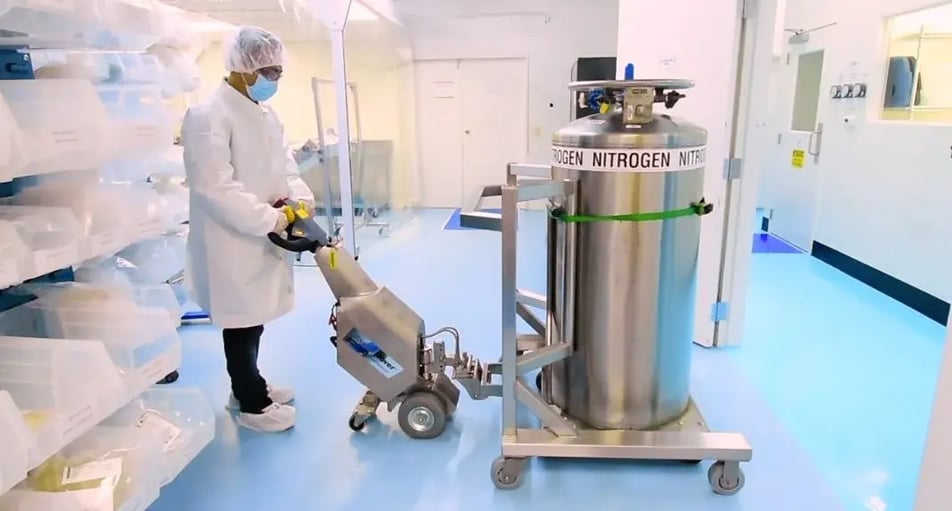
MasterMover’s Stainless Steel range offers established configurations for cleanroom classifications, including GMP environments.
Documentation for integration into quality management systems is supplied and a requirement that MasterMover has fulfilled across numerous regulated facilities.
A TYPICAL EXAMPLE
A leading biopharmaceutical contract manufacturer needed to move Cytiva's Axichrom 2000 chromatography columns – some of the largest on the market, weighing over 17,600kg when full – inside a tight, highly controlled cleanroom.
We walked them through our application evaluation process, gathering information on the load, environment and application. Our Application Engineers then specified a customised PS3000+ in high-grade 316 stainless steel with the higher grit finish the customer required, supplied with a full compliance document pack including polishing and pickle/passivation certificates.
ATEX hazardous area environments
MasterMover provides ATEX-certified solutions for facilities operating in environments with explosive atmospheres, such as chemical processing, oil and gas, and certain food production environments.
Customers are required to confirm the zone classification of their environment (Zone 1 or Zone 2) and MasterMover then manages the specification and certification process, working with accredited third-party specialists where required. Compliance documentation is supplied with the unit.
Cold storage environments
Sub-zero and blast freezer environments introduce specific demands on battery chemistry and performance.
MasterMover specifies battery technology options from lithium to AGM based on the usage, application and operating temperature range. This is a level of application-specific detail that off-the-shelf product selection does not account for.
Industrial manufacturing facilities
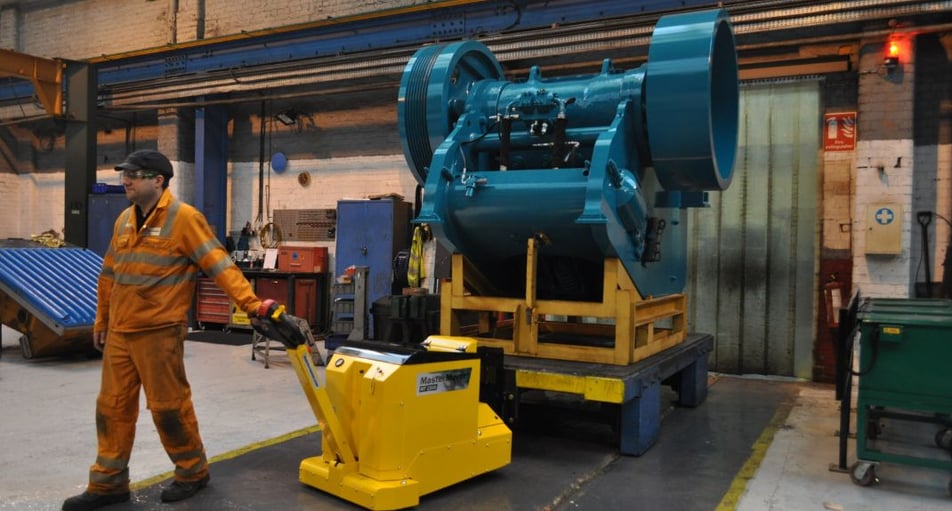
For aerospace, automotive and heavy plant manufacturing facilities, reliability is the difference between a solution that operators use, and one that sits in the corner of the factory gathering dust.
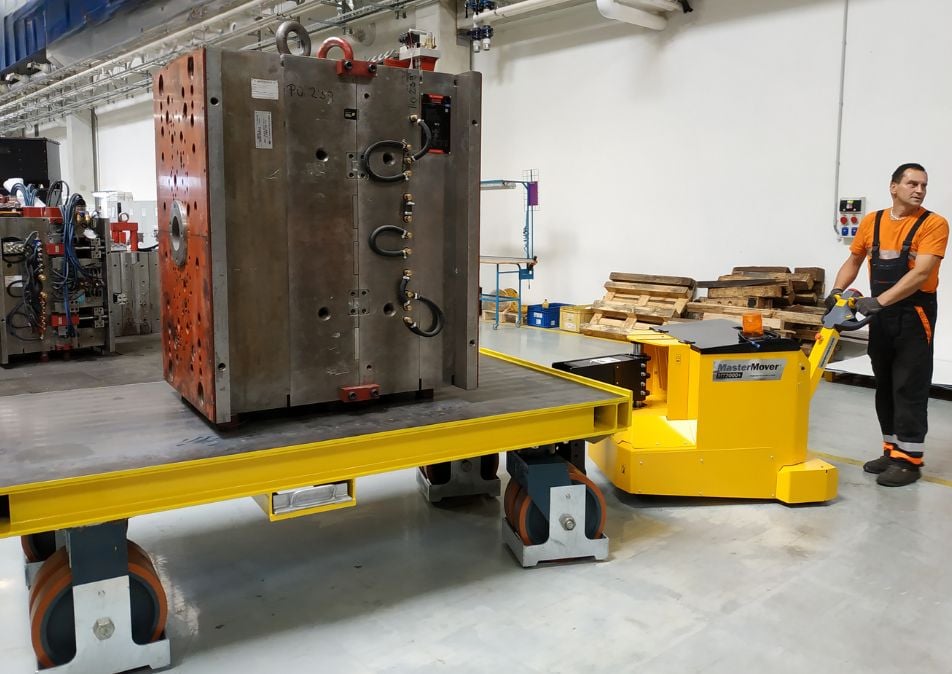
With an all-steel design, powerful weight capacity and safety built in, our solutions are used to move the weights we say they will, even up to 300,000kg.
A TYPICAL EXAMPLE
An aerospace composites manufacturer was using a competitor solution to load and unload an autoclave. The machine had been selected off-the-shelf and was undersized for the application, lacking the necessary power to pull the loaded composite layup trolleys from the autoclave.
MasterMover conducted a full application review, calculating the precise requirements for the load and surface conditions involved. We specified a MasterTug MT600+ model, which has been in successful continuous operation at the facility for several years.
Approaches of different suppliers
How do different suppliers approach specifying electric tugs?
Most electric tug suppliers will answer technical questions if you ask the right ones. MasterMover works differently.
We run the specification process on your behalf, from first conversation to confirmed solution. You describe your challenge. We translate it into a product specification, covering the right configuration, coupling system and any environment-specific requirements.
That approach reflects over 30 years of accumulated application knowledge across thousands of installations, from manoeuvring in tight pharmaceutical cleanrooms to complex movements of wind turbine blades reaching 100m in length.
The underlying risk in context:
~17%
of all non-fatal workplace injuries in Great Britain are manual handling injuries.
Source: HSE 2023, https://hse.gov.uk/statistics/causinj/
£7,500+
average direct cost to an employer per non-fatal injury causing 7+ days' absence
Source: HSE 2023, https://www.hse.gov.uk/statistics/economics/eauappraisal.htm
The organisations that contact MasterMover have typically already identified this risk. The question is how to address it, and how to do so with confidence.
Working with a trusted, vetted supplier is always important, but it is especially critical when the issue you're looking to solve is a safety challenge. It is essential that any solution works reliably and safely. An underpowered machine on a gradient, or a coupling that fails to stay connected, doesn't just create an operational inconvenience — it creates a RIDDOR-reportable incident.
What "properly specified" means
A correctly specified electric tug isn't just the right product for the load weight. It accounts for variables that only surface in the application review, and only matter when something goes wrong.
Two examples of how MasterMover approaches this differently:
Coupling systems
MasterMover specifies the right coupling system for every application. Hydraulic couplings are standard on many of our machines, providing a secure, controlled connection to the load. A poorly matched or flimsy coupling creates a point of failure that no amount of operator training resolves — one of the most common causes of unsafe load movement in facilities that have selected equipment without proper application review.
Slope performance
MasterMover always calculates worst-case slope performance for every application — specifying a machine capable of safely stopping and holding your load on the steepest gradient it will encounter. A machine that can move a load doesn't necessarily mean it can stop it safely on a slope.
This level of specification detail is what sets MasterMover apart and is why our solutions are engineered for safety, uptime and reliability. It's what makes the difference between a solution that performs reliably for years and one that creates the safety problem it was supposed to solve.
What to ask
What to ask any electric tug supplier
Not all suppliers approach specification the same way. The questions a supplier asks you (or doesn't ask) say a lot about the reliability of what you'll receive.
Before agreeing to any recommendation, ask the following:
What is this specification based on?
A reputable supplier should walk you through any proposal, clearly explaining why the product or model they have quoted is best suited to your application.
Have you calculated worst-case slope performance for my specific application?
A machine that can move a load on flat ground may not safely stop it on a gradient. Any competent supplier should be able to provide this calculation, specific to your environment.
What coupling system are you specifying, and why?
The connection between the tug and the load is a critical safety point. If a supplier can't explain their coupling choice in relation to your load and environment, that's a gap in the specification.
What happens if the standard product doesn't fit my application?
Some suppliers offer a catalogue. Others have the engineering capability to adapt and customise their solutions to better fit your requirements.
Why MasterMover
Why experience at scale changes the quality of a specification
MasterMover is an engineering-led business. That distinction matters because every application is treated as a technical problem with a right answer, not a sales process.
The consequences of inadequate specification are concrete. An uncertified product in an ATEX zone is a compliance failure. A coupling that hasn't been properly assessed creates a real risk of the load detaching. These real risks are exactly what MasterMover's application engineering process and machine range is designed to prevent.

That scale of implementation experience means that the application your team considers unusual - the tight cleanroom, the ATEX Zone 1 environment, the load that no standard coupling fits - has almost certainly been solved before.
MasterMover solutions are engineered, not catalogue-picked - and that's why they work.
Ready to find the solution for your application?
By redesigning load movement with electric tugger systems, facilities reduce injury risk and improve throughput. Fill out our form to see how electric tugs can help transform your operations.
Frequently asked questions
No, and it shouldn't be for the customer. There are variables that a reputable supplier needs to assess to ensure a reliable solution, but that assessment is MasterMover's responsibility, not the customer's. Our application engineering team gathers the right information about your application, reviews it, and presents a confirmed solution for your approval. You describe the challenge; we handle the specification.
MasterMover needs to understand the weight of the load being moved, the floor surface and operating environment, any space constraints, and some photographs of the load/trolley you’re looking to move. That's typically enough to produce a recommendation. For complex applications, or where we need to clarify aspects, we may ask for photographs or specific measurements. Our team will guide you through exactly what's needed.
No. MasterMover's application engineering team manages the full specification process. Customers describe the problem; MasterMover identifies the solution. No in-house engineering expertise is required.
Yes. MasterMover has proven configurations for pharmaceutical and cleanroom environments, backed by installations across numerous regulated facilities. Full compliance documentation can be supplied where required.
Yes. MasterMover supplies ATEX-certified pedestrian-operated tugs for both Zone 1 and Zone 2 classifications. Customers confirm the zone classification of their environment; MasterMover manages the specification and certification process, including working with accredited third-party specialists. Full compliance documentation is supplied with the unit.
Yes. For pharmaceutical and other regulated environment deployments, MasterMover can supply documentation to support with compliance.
No. Pedestrian-operated MasterMover electric tugs do not require the operator licences or formal certifications needed for forklifts. Operator familiarisation training sessions are available and will be offered during the specification process.
This entirely depends on your application and your timelines, but we’ve had solutions installed in as quickly as a few days for urgent short-term hire applications like our Flexi Hire offering. For most industrial applications, a more realistic timeframe is around 6-12 weeks depending on the machine and application. More complex projects, turnkey systems or custom designs will obviously have longer timeframes to account for the engineering and testing required.