United Kingdom
 Deutschland
 France
 Belgium
 Bulgaria
 Česká Republika
 Croatia
 Denmark
 España
 Finland
 Greece
 Hungary
 Iceland
 Ireland
 Italia
 Kazakhstan
 Latvia
 Lithuania
 Luxembourg
 Malta
Malta
 Nederland
 Norway
 Österreich
 Polska
 Portugal
 Romania
 Schweiz
 Slovakia
 Slovenia
 Sweden
 United States
 Canada
 Argentina
 Brasil
 Chile
Chile
 Colombia
 Costa Rica
 Cuba
Cuba
 Dominican Republic
 Ecuador
 El Salvador
 Guatemala
 Jamaica
 México
.svg.png?width=24&name=Flag_of_Peru_(state).svg.png) Peru
Peru
 Trinidad and Tobago
.png?width=24&name=Flag_of_Uruguay_(1828-1830).png) Uruguay
Uruguay
 Australia
 中国
中国
 中国香港
中国香港
 India
India
 Indonesia
 日本
日本
 대한민국
대한민국
 Malaysia
 New Zealand
 Pakistan
 Philippines
 Qatar
Qatar
 Saudi Arabia
 Singapore
 Taiwan
 Thailand
 Türkiye
 UAE
UAE
 Vietnam
 Algeria
 Egypt
Egypt
 Kenya
Kenya
 Mauritius
 Morocco
 South Africa
 Tunisia


Resilience and visibility with a dash of AI
Manufacturing has a habit of treating change as a series of projects, new software here, an automation cell there, with a new dashboard bolted on somewhere in between. But the trends shaping 2026 suggest a shift from adding tech to architecting operations that can actually absorb disruption and adapt quickly to prove what’s happening in real time.
That’s why some of the biggest themes you’ll keep seeing this year are resilience (staying productive through shocks) and visibility (knowing what’s really happening across your factory and supply network minute-by-minute), with AI and automation moving from experiments to strategy.
Supply chain resilience, agility built in
If the last few years have taught us anything, it's that disruption in manufacturing is no longer an anomaly. It has become vital for sector leaders to design in the ability for operations to absorb shocks, from multi-sourcing and approved alternates to flexible capacity and digital workflows that help teams reroute around disruption quickly.
Reshoring and nearshoring are proving to be a popular response to bring production closer to customers and shorten supply chains. Companies are pairing location strategy with supplier partnerships and process standardisation, so that they can shift volumes without reinventing each time. Resilience and reshoring will be a major focus throughout 2026 as businesses try to insulate operations from external pressures.
Cybersecurity investment
Cybersecurity has become a very real production concern. For manufacturers, lost production is a major risk and recent incidents such as the Jaguar Land Rover cyberattack highlight how quickly vulnerabilities become total operational shutdowns, costing them £50m per week from the end of August to the start of October.
At the sector level, Sophos’ 2025 ransomware report shows “successful encryption” has fallen to 40%, but recovery costs and data theft remain a major pressure.
Cybersecurity will be a priority for manufacturers going forward, needing top-level visibility of assets and access as well as secure remote connectivity. It will be vital for these organisations to build in a culture of security, with training at all levels to ensure it becomes a daily part of workflows.
Strategic AI adoption
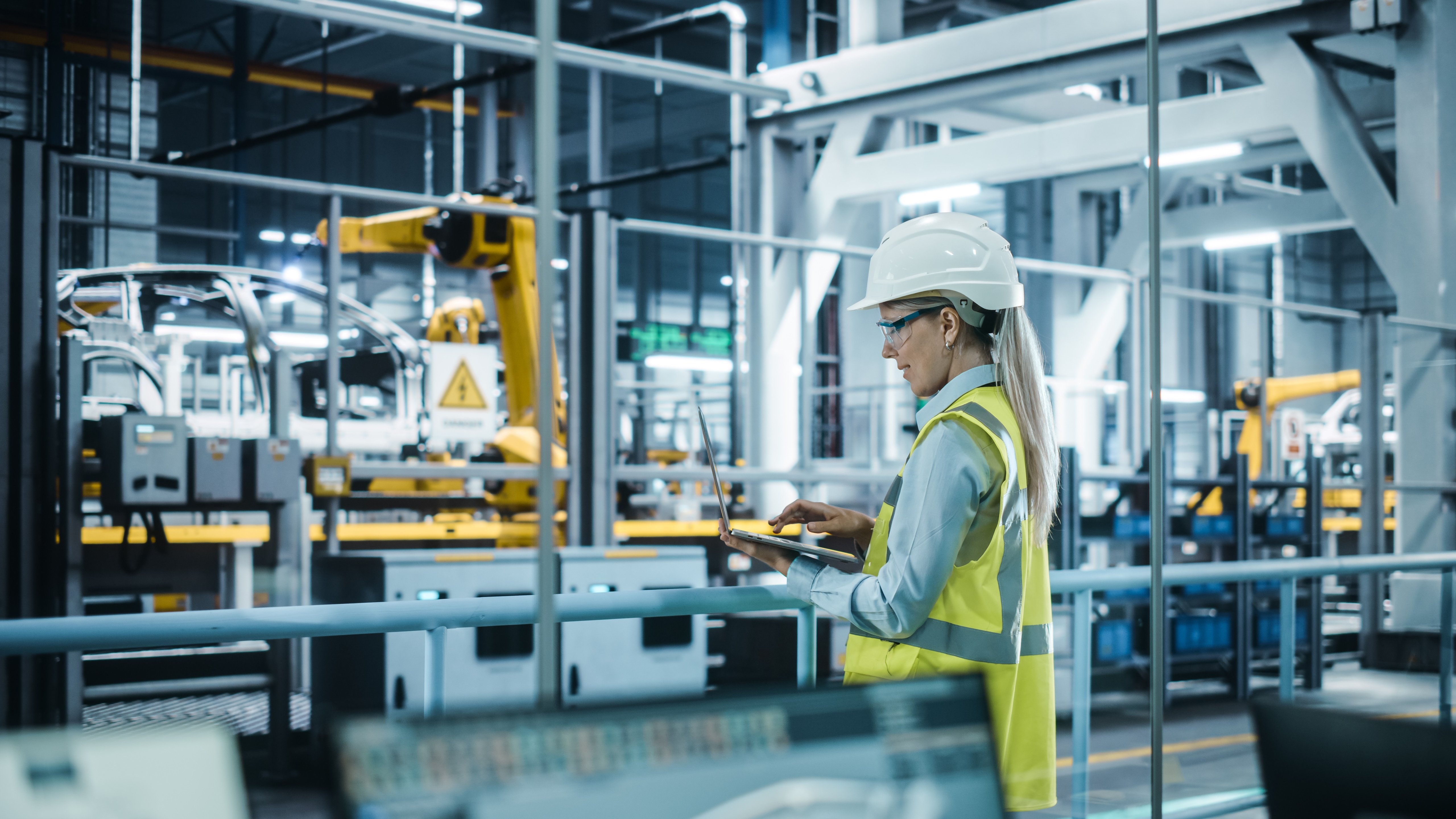
Now that AI is considered a key growth driver by most executives, it’s clear that it has rapidly evolved from just an exciting experiment to explore as a sideline project to now being a strategic implementation that is here to stay, with those not using it in this way likely to fall behind. There are two shifts happening at once:
AI becomes more 'agentic'
A lot of 2024-25 activity was AI producing analysis. The next step is AI taking controlled action, recommending what steps to take based on that analysis and triggering workflows, framed by many in the industry as moving from agentic pilots to scalable usage.
However, Gartner predicts that over 40% of agentic AI projects may be cancelled by the end of 2027 due to cost and unclear value or inadequate risk controls; a reminder for manufacturers to stay practical with AI implementation.
Generative AI moves from demo to production design
Picture a manufacturer entering new product specs into a generative AI system and getting back a ready-to-build design blueprint. In 2026, genAI is set to move beyond product demonstrations and pilots to real production.
Some manufacturers are already doing this. For example, Jacobs applied a generative design to develop an improved life-support backpack system for NASA, halving the weight of the device and reducing design time by 20%.
Many more manufacturers are expected to follow suit, incorporating AI-driven design into CAD workflows to speed up prototyping and make material usage more efficient.
Customers expect real-time visibility
Visibility is increasingly becoming the standard expectation. Even in more complex B2B manufacturing sectors, expectations are shifting toward ecommerce-like transparency, with buyers demanding real-time updates with clear lead times and proof of progress.
This pressure is forcing manufacturers to connect the dots between what’s happening internally and what is being communicated externally. The practical challenge here is that true visibility spans both digital and physical spheres: orders and schedules, but also assets, access, and monitoring across IT/OT environments.
The manufacturers that will pull ahead will be the ones that can visualise what’s happening end-to-end and use that shared picture to work faster with suppliers and customers.
Accessible automation
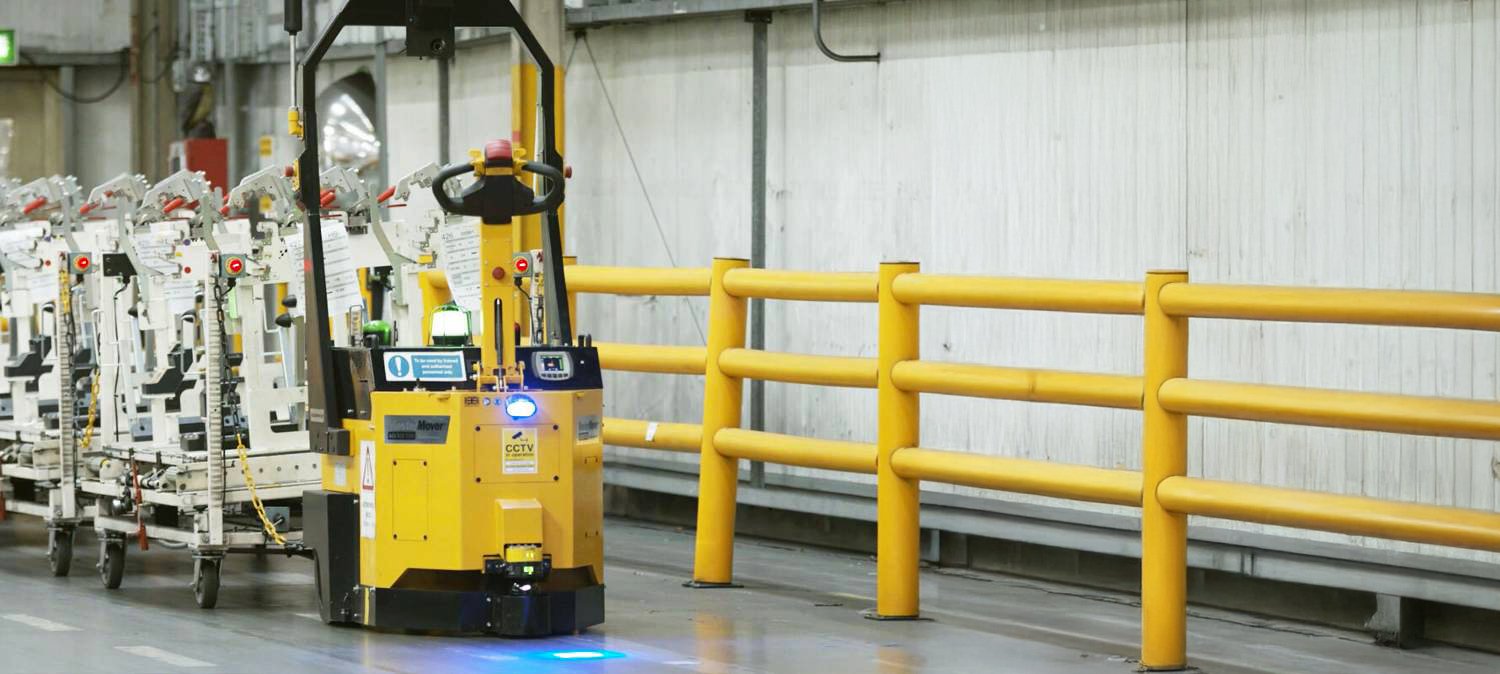
Automation is fast becoming more accessible, and it’s also becoming more strategic. In 2026, the biggest gains will come from intentional automation that is engineered around flow, safety, integration, and change management.
For large-scale projects, robotics and automation suppliers are also pushing AI-enabled programming and more virtual commissioning using digital twins to shorten deployment time and reduce risk. Even still, the main differentiator and key to real automation ROI and success will be in the way it is designed into the business’s existing operations and workflows, over-simplified plug-and-play automation solutions simply don’t work.
For intralogistics especially, complex site layouts, traffic rules, interfaces with WMS/ERP, pedestrians working alongside vehicles, and how exceptions are handled matter just as much as the hardware. This is why the best results come from collaborative project scoping where suppliers truly partner with businesses to understand application-specific requirements and complexities, ensuring that the solution is an engineered-fit – as well as proving the flow, validating safety and performance, and providing ongoing support to adapt the solution as requirements change and scale.
Automation wins don’t come from buying a ready-made product and hoping it fits. The most reliable results come from collaborative suppliers who set out to understand the full movement of materials and what ‘success’ looks like for the customer. That’s how you get AGVs you can trust: built on decades of material handling expertise and engineered to fit the application with total integration that scales.

Where this leaves manufacturers in 2026
Those that see real success this year will be the manufacturers building operations that can flex and recover. Resilience and visibility are becoming the ore product, and the technologies that matter most will only deliver when they're managed strategically and implemented with the people running the processes each day.